2024 John Hintermister Gainesville Christmas Bird Count

In 2022 a late afternoon thunderstorm gave us a good soaking and in 2023 an entire morning of bluster and squalls dampened our spirits. This year, the 2024 John Hintermister Gainesville Christmas Bird Count had dry skies, mild temperatures, and happy birders. The birds themselves put on quite the show this year: we tied our all-time high record of 175 species! And, for the first time, we topped 100,000 individuals, with 106,204 birds tallied! We should maintain our solid positions as one of the highest inland counts in the United States, and as tops for species number in Florida. Our intrepid observers were dispersed among eleven teams, each with a team captain. As we ran through the tallies of the regularly occurring species at the compilation on Sunday evening, anticipation mounted with each addition (see below) and with each species missed (Horned Grebe, American Pipit, Wil son’s Warbler, Field Sparrow, and Indigo Bunting). Excitement peaked as each team captain read the rare species found in their sector on count day. Three new species were recorded for the first time on this CBC: a Bell’s Vireo on the edge of Payne’s Prairie (Team 1), a Cape May Warbler visiting a suburban feeder in NE Gainesville (Team 10), and a pair of Red-throated Loons on Newnan’s Lake (Team 11). The day’s rarities were nicely distributed in all sectors and included: Team 1: Fulvous Whistling-Duck, Cinnamon Teal, 3 Gray-headed Swamphen, Least Flycatcher, Ash-throated Flycatcher, Bell’s Vireo; Team 2: Common Goldeneye, Ash-throated Flycatcher; Team 3: Yellow-crowned Night Heron, 5 Golden-crowned Kinglets, Brown Creeper, Winter Wren, 2 Bachman’s Sparrow, Team 4: Red-breasted Merganser, Barn Swallow; Team 5: Ash-throated Flycatcher; Team 6 5 Golden crowned Kinglets Tropical Kingbird, Team 7: Ash-throated Flycatcher, Black-throated Green Warbler, Lincoln’s Sparrow, Team 8 Magnolia Warbler (had only been seen once before in 1990); Team 9: Western Tanager, Team 10: Golden-crowned Kinglet, Cape May Warbler, Bachman’s Sparrow; Team 11: Red-throated Loon. With those last additions, and a final perusal of documentation, we had reached our previous record, set in 2019. The bread and butter of a Christmas Bird Count, however, is determining the population status of the area’s more common species, which can aid in determining conservation planning for our mostly declining avifauna. For our 2024 count, our 120 + observers reached new all-time high counts for 16 species: Northern Pintail, American Bittern, Northern Harrier, Barred Owl, Eastern Phoebe, Vermilion Flycatcher, Carolina Chickadee, Tufted Titmouse, Gray Catbird, House Wren, American Robin, House Finch, Black & White Warbler, Orange crowned Warbler, Yellow-breasted Chat, Swamp Sparrow. Especially notable were numbers of fruit eaters like American Robin (42,692!), Gray Catbird, and Cedar Waxwing. The numbers of flocking woodland species were also high, with records for Tufted Titmouse, Carolina Chickadee, Black-and-white Warbler, and Orange-crowned Warbler. Thankfully, Alachua County, with its expansive network of protected areas, woods, lakes, and prairies, continues to harbor important wintering populations of a wide assortment of bird species. Species list (bold-faced species = rarity; bold-faced count = high count): Black-bellied Whistling-Duck 4213, Fulvous Whistling-Duck 1, Snow Goose 5, Muscovy Duck 206, Wood Duck 229, Gadwall 33, American Wigeon 7, Mallard 10, Mottled Duck 283, Blue-winged Teal 1056, Cinnamon Teal 1, Northern Shoveler 24, Northern Pintail 985 (HC), Green-winged Teal 2890, Redhead 1, Ring-necked Duck 9863, Lesser Scaup 85, Common Goldeneye 1, Bufflehead 27, Red-breasted Merganser 3, Hooded Merganser 220, Ruddy Duck 76, Northern Bobwhite 24, Wild Turkey 125, Pied-billed Grebe 60, Rock Pigeon 24, Eurasian Collared Dove 2, Common Ground-Dove 17, Mourning Dove 491, White-winged Dove 1, Whip-Poor-Will 6, Ruby-throated Hummingbird 5, Rufous Hummingbird 1, King Rail 14, Virginia Rail 35, Sora 124, Purple Galli nule 4, Gray-headed Swamphen 3, Common Gallinule 577, American Coot 619, Limpkin 168, Sandhill Crane Page 11 The Crane Alachua Audubon Society Volume 66 Number 3 Jan – Feb 2025 1842, Killdeer 242, Least Sandpiper 31, Wilson’s Snipe 220, Long-billed Dowitcher 3, American Woodcock 6, Spotted Sandpiper 2, Greater Yellowlegs 27, Lesser Yellowlegs 12, Bonaparte’s Gull 8, Laughing Gull 18, Ring billed Gull 259, Herring Gull 2, Forster’s Tern 31, Common Loon 8, Red Throated Loon 2, Wood Stork 133, Double-crested Cormorant 788, Anhinga 409, American White Pelican 130, American Bittern 33 (HC), Least Bit tern 27, Great Blue Heron 227, Great Egret 262, Snowy Egret 177, Little Blue Heron 234, Tricolored Heron 102, Cattle Egret 309, Green Heron 38, Black-crowned Night-Heron 217, Yellow-crowned Night-Heron 1, White Ibis 2271, Glossy Ibis 419, Roseate Spoonbill 6, Black Vulture 451, Turkey Vulture 1399, Osprey 25, Snail Kite 112, Bald Eagle 143, Northern Harrier 111 (HC), Sharp-shinned Hawk 7, Cooper’s Hawk 17, Accipiter, sp. 2, Red shouldered Hawk 235, Red-tailed Hawk 40, Barn Owl 6, Eastern Screech-Owl 24, Great Horned Owl 42, Barred Owl 81 (HC), Belted Kingfisher 61, Red-headed Woodpecker 32, Red-bellied Woodpecker 526, Yellow-bellied Sap sucker 101, Downy Woodpecker 234, Northern Flicker 67, Pileated Woodpecker 179, American Kestrel 73, Merlin 3, Peregrine Falcon 1, Eastern Phoebe 602 (HC), Vermilion Flycatcher 7 (HC), Least Flycatcher 1, Tropical Kingbird 1, Ash-throated Flycatcher 5, Loggerhead Shrike 33, White-eyed Vireo 75, Blue-headed Vireo 82, Bell’s Vireo 1, Blue Jay 240, American Crow 813, Fish Crow 131, Crow, sp. 67, Tree Swallow 698, Barn Swallow 1, Carolina Chickadee 582 (HC), Tufted Titmouse 686 (HC), Brown-headed Nuthatch 22, Brown Creeper 1, House Wren 331 (HC), Winter Wren 1, Sedge Wren 117, Marsh Wren 54, Carolina Wren 595, Blue-gray Gnatcatcher 548, Ruby-crowned Kinglet 728, Golden crowned Kinglet 11, Eastern Bluebird 325, Hermit Thrush 65, American Robin 42692 (HC), Gray Catbird 384 (HC), Brown Thrasher 23, North ern Mockingbird 194, European Starling 15, Cedar Waxwing 2038, House Sparrow 31, House Finch 173 (HC), American Goldfinch 333, Ovenbird 9, Northern Waterthrush 12, Black-and-White Warbler 175 (HC), Orange-crowned Warbler 182 (HC), Common Yellowthroat 326, American Red start 3, Northern Parula 4, Magnolia Warbler 1, Cape May Warbler 1, Palm Warbler 1197, Pine Warbler 221, Yel low-rumped Warbler 2364, Yellow throated Warbler 57, Black-throated Green Warbler 1, Prairie Warbler 3, Yellow-breasted Chat 5 (HC), Eastern Towhee 69, Chipping Sparrow 834, Vesper Sparrow 8, Savannah Sparrow 204, Grasshopper Sparrow 12, Hens low’s Sparrow 4, Bachman’s Sparrow 3, Song Sparrow 43, Lincoln’s Spar row 1, Swamp Sparrow 610 (HC), White-throated Sparrow 28, White crowned Sparrow 3, Summer Tanager 3, Western Tanager 1, Northern Cardinal 726, Painted Bunting 25, Red winged Blackbird 7517, Eastern Meadowlark 84, Rusty Blackbird 125, Common Grackle 1382, Boat-tailed Grackle 1872, Brown-headed Cowbird 351, Baltimore Oriole 42.

By Andy Kratter
The June Challenge 2025

The 2025 June Challenge

By Rex Rowan

The birders in June won’t be nappin’
When a rarity comes a-flappin’.
They won’t miss the word
About a good bird —
They’re twenty-four-seven WhatsAppin’!

By Mike Manetz

Mike Manetz’s annual June Challenge limerick was spot on. I won’t go so far as to say that sitting at my computer and following the discoveries on WhatsApp was as exciting as actually being in the hunt, but it was pretty exciting nonetheless! Let’s say a WhatsApp post announces a rarity at Watermelon Pond in the southwest corner of the county. Oh woe, writes John in a response, I am many miles to the east at Newnans Lake! I will jump in my car and head across the county to Watermelon Pond! Forty-five minutes later, John posts a line of sad-face emojis and writes that the Watermelon Pond bird has vanished! Ten seconds later Trudy posts a sighting of a new rarity – at Newnans Lake! John writes, “Keep it there for me!” and jumps in his car and heads back to where he started from! Will he be successful this time? Will the rarity fly away the moment he pulls into the parking lot? Stay tuned! This maddening but not even slightly unusual bird behavior, appearing and then disappearing and then appearing again and then disappearing again and then appearing somewhere else – I’m looking at you, Willet! – played out day after day on WhatsApp during June. When Bob Wallace founded the Alachua County Birding Facebook page in 2013, this is exactly what he was hoping for: you see a rarity, a few seconds later you post your sighting, your sighting is instantaneously distributed to other local birders, and twenty people are enroute before you’ve even put your phone back in your pocket. Facebook turned out to be unsuitable for this because rare bird sightings got buried under highlights from the Gator game, a GoFundMe appeal from some guy who wanted to make the glazed doughnut the State Pastry, and seventeen pictures of your sister’s cat. So it’s proper to remember and recognize that it was Peter Polshek who spent years urging us to switch over to WhatsApp before we actually did it. Peter, you have our belated thanks.
The spring that preceded this year’s Challenge was not auspicious. Actually, since “auspice” means “an observation of birds for the purpose of obtaining omens,” spring was in fact extremely auspicious: finding migrants in April and May was like pulling teeth, and that’s always a bad omen for June birding. By late March the last mud flats on Paynes Prairie’s central basin were drying up, and by June they were gone. Preston Ballard wrote, “Ben Fick and I did about a 7–8-mile hike out there from Bolen Bluff on June 3rd. There was no water and nearly no mud at all. Just a sea of grass – quite tall grass, truly a prairie….I really wonder if Levy Lake or Barr Hammock or something might have mud somewhere? At this point I’m just hoping to even get a single Semipalmated Sandpiper. If anyone knows where literally any mud would be right now please do share.” There was in fact a little bit of mud left on the Prairie, not quite an acre, running along the east side of US-441 near Bolen Bluff. Initially it attracted great numbers of water birds, mostly local nesters like Mottled Ducks, Black-necked Stilts, and herons, but also Roseate Spoonbills (up to 50!) and two Blue-winged Teal. But a few days into the Challenge it started to attract a more exotic clientele: on the 4th a Caspian Tern showed up, on the 7th a Stilt Sandpiper, and on the 12th a Short-billed Dowitcher, only the second-ever June occurrence for Alachua County. A couple of other spots held enough water for a shorebird or two: Preston found a Lesser Yellowlegs at the Hague dairy on the 1st. Richard Kaskan found a one-legged Spotted Sandpiper at Sweetwater Wetlands Park on the 11th, a Greater Yellowlegs at Watermelon Pond on the 14th, and a Willet at the Butler Plaza retention ponds on the 26th. That was it for migrant shorebirds, six species, which is actually quite good for a normal June Challenge; we’ve been spoiled by the abundance of the past few years.
A bigger story than the paucity of shorebirds this year was the variety of terns. If we’re going to see several species of terns during a June Challenge, we usually require a tropical storm to blow them inland. But we didn’t have a tropical storm this June, and the terns came inland anyway, maybe just out of habit at this point. First – and I need to take a deep breath before I start typing – first was a Black Tern at Newnans Lake on the 3rd, then the Caspian at the 441 mud flats on the 4th (remaining through the 8th), a Forster’s at Lake Lochloosa on the 5th, a Least and three Commons at Newnans on the 6th, another Black Tern, this one at Watermelon Pond on the 8th, another Least and five Commons at Newnans on the 9th, two more Commons at Bivens Arm on the 10th, two Forster’s at Newnans, and yet another two Commons and a Least at Lochloosa on the 11th, a Sandwich at Newnans on the 12th through the 14th (only the second June occurrence in the county), a Royal at Newnans on the 14th, another Least at Newnans on the 15th, a Forster’s at Orange Lake on the 18th, and another Black at Watermelon Pond on the 19th. Toward the end of the month Tim Hardin arranged boat trips that found a Common Tern on Lake Santa Fe on the 21st and two Royals on Santa Fe on the 28th. That’s 29 terns of seven species. All in fair weather. And I’m not counting the many “tern sp.” that were too distant to identify.
Miscellaneous rarities were few this year: a Ring-necked Duck off the 441 observation platform during most of the month and five more at Barr Hammock, a Bobolink on the 1st, only the fourth June record for the county, a Brown Pelican at Newnans on the 17th and 18th and another at Orange Lake on the 18th, and an American Goldfinch at a Micanopy feeder during the first few days of the month and then again during the last few. Two birders who weren’t participating in the Challenge – I know, crazy, right? – saw birds that no one else did: Jonathan Mays saw a Gray Catbird in southeast Gainesville on the 19th and passed the information on to me, but none of the birders who looked for it were able to relocate it. And Jean Lansford photographed a Rose-breasted Grosbeak in the Idylwild neighborhood on the 3rd, the county’s first June record ever. Ms. Lansford did not notify anyone of this. Perhaps she foresaw the stampede of birders on her front porch and decided against it.
Sadly, the ultra-rare White-breasted Nuthatch that visited Geoff Parks’ yard on May 22nd didn’t stick around to be seen during the Challenge.
As usually happens, the last five days of the month saw the beginning of fall migration: the aforementioned Willet on the 26th, a Belted Kingfisher at Sweetwater Wetlands Park on the 27th, a Pied-billed Grebe at Sweetwater and a Louisiana Waterthrush along the Santa Fe River on the 28th, and a trifecta on the 30th, a Louisiana Waterthrush, a Belted Kingfisher, and a Black-and-white Warbler along the Santa Fe River on the 30th.
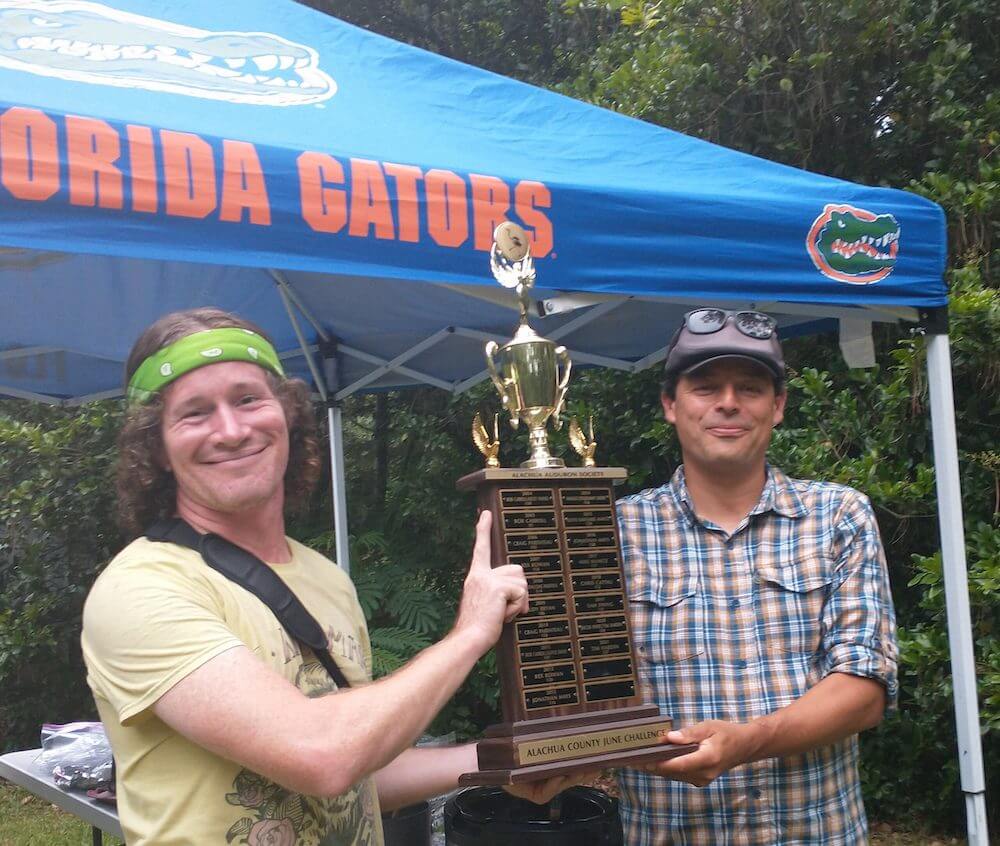
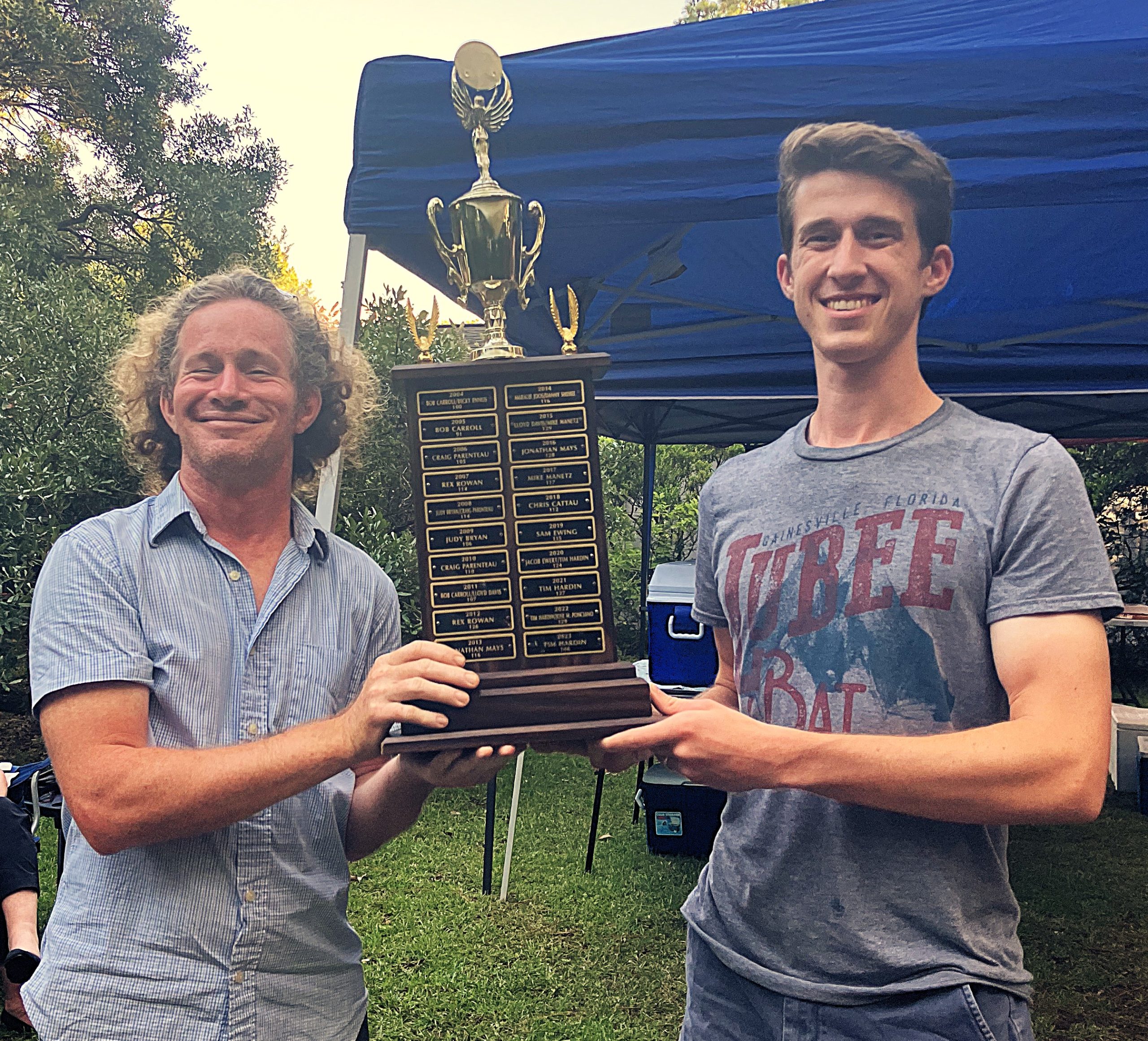
Eight times in the previous 21 June Challenges we’ve had a two-way tie for first place. This year it happened for the ninth time, and in addition we had our first-ever two-way tie for second place. Since that’s already four people, there was no third-place winner this year. Our first-place winners were Ben Fick, who holds the record for the second-highest June Challenge total ever (145 in 2023), and, for the sixth time in a row (!), Tim Hardin. We’ll be retiring Tim’s number in a small ceremony later this year, prior to inducting him into the June Challenge Hall of Fame. Both Ben and Tim saw 131 species. Tied for second place with 129 species were Preston Ballard and Dottie Dreyer. Preston, who is currently tied with Tim Hardin for the most bird species seen in Alachua County in 2025, discovered or was involved in the discovery of some of the Challenge’s best birds, such as the Sandwich Tern and the Short-billed Dowitcher. Dottie made a real impression on me a couple of years ago when she offhandedly mentioned that she had been wandering through the pines at Longleaf Flatwoods Reserve at 11:00 at night, searching for (I think) a screech owl. My mind is still boggled by that. This year we also had an entry in the under-18 category, Ollie Flanagan. Ollie is 17 and a student of another Challenger, Ellen Frattino. Ollie vows to be back next year with a driver’s license and a car and will give all of us elderly folks a run for our money.
Everyone – not just the winners – should report his or her totals to FWC’s statewide June Challenge page here. The deadline is July 7th, so hurry! (Yeah, I know. My fault.) It takes about two minutes to complete.
On to the numbers. Taking all the winning totals from 2004 to 2025 and lopping off the two lowest and the two highest, the average of the rest is 118. We first beat that average in the ninth year of the Challenge, 2012, but we’ve beaten it every year since 2019, six years in a row. This year’s were the third-highest winning totals in the 22 years that we’ve been doing this. Anyway, here are the results. Ties are listed in alphabetical order by last name.

Ben Fick  131, Tim Hardin  131, Preston Ballard  129, Dottie Dreyer  129, Raci Ulusoy  128, Eileen Ahlquist  127, Ellen Frattino  125, Sharon Kuchinski  122, Bert Foquet  120, Mark Gorday  120, Anne Casella  119, Pelin Karaca  117, Pratibha Singh  117, Kristen Suggs  116, Tina Greenberg  113, Barbara Shea  111, Renee Slaw  111, Chris Cattau  109, Richard Kaskan  107, Austin Gregg  102, Jeanette Matheny  102, Bob Carroll  101, Glenn Israel  100, Diane Pruitt  100, Jerry Pruitt  100, Eric Link  98, , Tonya Becker  96, Rex Rowan  96, Becky Enneis  95, Emily Schwartz  94, Linda Holt  93, Judith Hunt  92, John Martin  89, Will Salmon 88, Cyndi Dunphy  86, Jamielee Thompson  84, Stephanie Hornbuckle  82, Tom Wronski  81, Anne Barkdoll  54.

Under-18 Category: Oliver Flanagan  53

We also had an out-of-county entry: Lackawanna County, Pennsylvania. Richard Carroll 47. (Richard, age 14, is Bob Carroll’s nephew, and this is his third June Challenge!) (Good work, Richard, and good work, Bob!)

And here’s the complete list of bird species seen in Alachua County during the Challenge (not all were seen by all participants):

Black-bellied Whistling-Duck, Canada Goose, Muscovy Duck, Wood Duck, Blue-winged Teal, Mallard, Mottled Duck, Ring-necked Duck, Northern Bobwhite, Wild Turkey, Pied-billed Grebe, Rock Pigeon, Eurasian Collared-Dove, Common Ground Dove, White-winged Dove, Mourning Dove, Yellow-billed Cuckoo, Common Nighthawk, Chuck-will’s-widow, Chimney Swift, Ruby-throated Hummingbird, King Rail, Common Gallinule, American Coot, Purple Gallinule, Gray-headed Swamphen, Limpkin, Sandhill Crane, Black-necked Stilt, Killdeer, Stilt Sandpiper, Short-billed Dowitcher, Spotted Sandpiper, Lesser Yellowlegs, Willet, Greater Yellowlegs, Laughing Gull, Least Tern, Caspian Tern, Black Tern, Common Tern, Forster’s Tern, Royal Tern, Sandwich Tern, Wood Stork, Anhinga, Double-crested Cormorant, American White Pelican, Brown Pelican, Least Bittern, Little Blue Heron, Tricolored Heron, Snowy Egret, Yellow-crowned Night Heron, Black-crowned Night Heron, Green Heron, Great Egret, Western Cattle Egret, Great Blue Heron, White Ibis, Glossy Ibis, Roseate Spoonbill, Black Vulture, Turkey Vulture, Osprey, Swallow-tailed Kite, Cooper’s Hawk, Bald Eagle, Mississippi Kite, Snail Kite, Red-shouldered Hawk, Broad-winged Hawk, Short-tailed Hawk, Red-tailed Hawk, American Barn Owl, Eastern Screech-Owl, Great Horned Owl, Burrowing Owl, Barred Owl, Belted Kingfisher, Red-headed Woodpecker, Red-bellied Woodpecker, Downy Woodpecker, Northern Flicker, Pileated Woodpecker, American Kestrel, Great Crested Flycatcher, Eastern Kingbird, Eastern Wood-Pewee, Acadian Flycatcher, White-eyed Vireo, Yellow-throated Vireo, Red-eyed Vireo, Loggerhead Shrike, Blue Jay, American Crow, Fish Crow, Carolina Chickadee, Tufted Titmouse, Bank Swallow, Northern Rough-winged Swallow, Purple Martin, Barn Swallow, Brown-headed Nuthatch, Blue-gray Gnatcatcher, Carolina Wren, Gray Catbird, Brown Thrasher, Northern Mockingbird, European Starling, Eastern Bluebird, House Sparrow, House Finch, American Goldfinch, Bachman’s Sparrow, Eastern Towhee, Yellow-breasted Chat, Bobolink, Eastern Meadowlark, Orchard Oriole, Red-winged Blackbird, Brown-headed Cowbird, Common Grackle, Boat-tailed Grackle, Louisiana Waterthrush, Black-and-white Warbler, Prothonotary Warbler, Common Yellowthroat, Hooded Warbler, Northern Parula, Pine Warbler, Yellow-throated Warbler, Summer Tanager, Northern Cardinal, Rose-breasted Grosbeak, Blue Grosbeak.


The June Challenge – 2024

I had low expectations for this year’s Challenge. After last year’s record-setting results it felt like a reset was in order – a return to normalcy, as it were – especially given our near-drought conditions, the exhausting heat, and the scarcity of lingering migrants during the latter half of May (not a single White-rumped Sandpiper, for instance). We might break 110 species, but no one would get to 120.
Our kickoff field trip on the morning of the 1st was fine, but there were no surprises. We found our target birds at Longleaf Flatwoods Reserve, got Bald Eagle but missed Laughing Gull at Owens-Illinois Park, located a known pair of Green-winged Teal at La Chua (the female flightless), and checked off a couple of tough but expected birds at Sweetwater, a King Rail and a Short-tailed Hawk. Notably absent were migratory shorebirds.
On the eve of the Challenge, on May 31st, Chris Cattau had walked out to Alachua Lake from the northeast and found some mud flats, and on those mud flats were the missing migratory shorebirds: a White-rumped Sandpiper, a Semipalmated Plover, 15 Semipalmated Sandpipers, a Least Sandpiper, a Greater Yellowlegs, and a Lesser Yellowlegs. Those who were willing to follow his example added those half-dozen species to their June Challenge lists. And on the 3rd, visiting Belgian entomologist Bert Foquet bushwhacked out the La Chua Trail to the observation platform – which we should all be able to do, Park Service! – and saw a female Bobolink, Greater and Lesser Yellowlegs, and Least and Semipalmated Sandpipers.
Otherwise the first couple of weeks were quiet. The usual field trips to Watermelon Pond for the Burrowing Owls, to La Chua at sundown for the county’s other four resident owl species, and to San Felasco for Hooded Warbler, Acadian Flycatcher, and Eastern Wood-Pewee, all came off as usual, and we found most of the birds we were looking for (except Orchard Oriole, which was even scarcer than usual this month and looks to be headed down the same road as Hairy Woodpecker). Four pontoon boat trips went out onto Lake Santa Fe in hopes of finding stray coastal birds, but all four of them struck out completely.
On the 15th Tim Hardin sighed, “It is SO hot. Never saw full-shade beautyberry bushes in hammocks withered from heat and dryness until the last week.” But that afternoon the first rains came. And then strong east winds began to blow, and continued to do so for several days, bringing pelagic birds to the Atlantic coast and coastal birds to Alachua County. On the 18th Lloyd Davis found a Gull-billed Tern at La Chua, while Maggie Paxson and Dottie Dreyer found a Caspian Tern at Orange Lake. By the next day the first Gull-billed had been joined by a second, and both had been joined by five Black Terns, while at the 441 causeway Bert Foquet spotted two Lesser Yellowlegs, the first of many birds that would bring birders flocking to 441. On the 22nd Tim issued an open invitation for birders to join him on the 441 observation deck, and in addition to hundreds of Wood Storks, Great Blue Herons, and Great and Snowy Egrets they managed to find both yellowlegs, a Caspian Tern, and at least two Lesser Scaup. All were at a great distance, identified through spotting scopes, so of course some birders were inspired to walk out to where those birds were, and there they discovered other species, like a Black-bellied Plover and a pair of Blue-winged Teal.
The last week of the month was more lively than we had any right to expect. On the 24th a pontoon boat trip to Newnans Lake found a Willet. On the 25th Raci Ulusoy and Pelin Karaca found a Lark Sparrow at Watermelon Pond, accurately described by Maggie Paxson as an “absolutely NUTS June bird.” On the 27th Dottie Dreyer and Tina Greenberg found a Louisiana Waterthrush at Chapmans Pond, and on the 28th Tim spotted a Common Tern off the 441 observation deck. On the morning of the 29th Lloyd Davis discovered a Yellow-crowned Night Heron at the old water-control structure at La Chua, and Mark Gorday found 2 to 4 Black-and-white Warblers at Palm Point. And on the last day of the month Tim Hardin saw Yellow-breasted Chats on Paynes Prairie east of Bolen Bluff and a Spotted Sandpiper at Palm Point.
Though it started slow, June 2024 went out with a bang, largely thanks to Alachua County birders, who weren’t discouraged by heat or slow birding, but who throughout the month swarmed over the county, tireless, endlessly excited and interested, always eager for another adventure, intent on finding every bird there was. Mike Manetz started talking about this several months ago, how Alachua County’s birding community is like a finely-woven net that lets nothing through, that catches every bird crossing the county line. An accomplished limericist, if that’s what a maker of limericks is called, Mike was inspired by this year’s June Challenge to express his admiration:

Their June Challenge plans perfected,
Alachua birders reflected.
They all did agree,
Their motto would be,
“No bird shall pass undetected.”

And no bird did. Congratulations, guys.

Remember to submit your list to the statewide June Challenge site operated by FWC’s Great Florida Birding and Wildlife Trail: https://floridabirdingtrail.com/june-challenge/

And here are our winners, all 38 of them. (Alphabetical order by last name in case of a tie.) This was our second-best June Challenge ever in terms of number of species. From 2004 to 2022, the winning total never exceeded 129. We beat that total last year – we beat it to death, really – and we beat it again this year. Congratulations to Tim Hardin, who has now won or tied for first place five years in a row, and congratulations likewise to Bert Foquet, who won the very first June Challenge he ever participated in. Our second- and third-place finishers, Raci Ulusoy and Eileen Ahlquist, are also relative newcomers to Alachua County birding, and have done themselves proud.

Bert Foquet and Tim Hardin tied for 1st place.
Raci Ulosoy took 2nd place.

Eileen Ahlquist took 3rd place.

Bert Foquet  135
Tim Hardin  135
Raci Ulusoy  130
Eileen Ahlquist  128
Dottie Dreyer  126
Tina Greenberg  124
Pelin Karaca  124
Ellen Frattino  120
Kristen Suggs  118
Sharon Kuchinski  117
Mark Gorday  113
Brent Henderson  110
Rene Slaw  110
Jerry Pruitt  109
Rex Rowan  108
Anne Casella  106
Pratibha Singh  104
Eric Link  102
John Martin  101
Bob Carroll  100
Jeanette Matheny  100
Maggie Paxson  99
Christine Zamora  96
Tonya Becker  95
Chris Cattau  93
George Becker  92
Becky Enneis  87
Jamielee Thompson  85
Emily Schwartz  83
Debbie Roberts  81
Debbie Segal  81
Howard Adams  77
Austin Gregg  71
Marcus Zokan  66
Linda Holt  63
Cyndi Dunphy  61
Dotty Robbins  22

Finally, here’s the complete list of bird species recorded in Alachua County during this year’s Challenge:

Black-bellied Whistling-Duck, Canada Goose Muscovy Duck, Wood Duck, Blue-winged Teal, Mallard, Mottled Duck, Green-winged Teal, Ring-necked Duck, Greater Scaup, Lesser Scaup, Northern Bobwhite, Wild Turkey, Pied-billed Grebe, Rock Pigeon, Eurasian Collared-Dove, Common Ground Dove, White-winged Dove, Mourning Dove, Yellow-billed Cuckoo, Common Nighthawk, Chuck-will’s-widow, Chimney Swift, Ruby-throated Hummingbird, King Rail, Common Gallinule, American Coot, Purple Gallinule, Gray-headed Swamphen, Limpkin, Sandhill Crane, Whooping Crane, Black-necked Stilt, Black-bellied Plover, Killdeer, Semipalmated Plover, Least Sandpiper, White-rumped Sandpiper, Semipalmated Sandpiper, Spotted Sandpiper, Lesser Yellowlegs, Willet, Greater Yellowlegs, Laughing Gull, Least Tern, Gull-billed Tern, Caspian Tern, Black Tern, Common Tern, Forster’s Tern, Royal Tern, Wood Stork, Anhinga, Double-crested Cormorant, American White Pelican, Least Bittern, Great Blue Heron, Great Egret, Snowy Egret, Little Blue Heron, Tricolored Heron, Cattle Egret, Green Heron, Black-crowned Night Heron, Yellow-crowned Night Heron, White Ibis, Glossy Ibis, Roseate Spoonbill, Black Vulture, Turkey Vulture, Osprey, Swallow-tailed Kite, Cooper’s Hawk, Bald Eagle, Mississippi Kite, Snail Kite, Red-shouldered Hawk, Broad-winged Hawk, Short-tailed Hawk, Red-tailed Hawk, Barn Owl, Eastern Screech-Owl, Great Horned Owl, Burrowing Owl, Barred Owl, Red-headed Woodpecker, Red-bellied Woodpecker, Downy Woodpecker, Northern Flicker, Pileated Woodpecker, American Kestrel, Great Crested Flycatcher, Eastern Kingbird, Eastern Wood-Pewee, Acadian Flycatcher, White-eyed Vireo, Yellow-throated Vireo, Red-eyed Vireo, Loggerhead Shrike, Blue Jay, American Crow, Fish Crow, Carolina Chickadee, Tufted Titmouse, Northern Rough-winged Swallow, Purple Martin, Barn Swallow, Brown-headed Nuthatch, Blue-gray Gnatcatcher, Carolina Wren, Brown Thrasher, Northern Mockingbird, European Starling, Eastern Bluebird, House Sparrow, House Finch, Bachman’s Sparrow, Lark Sparrow, Eastern Towhee, Yellow-breasted Chat, Bobolink, Eastern Meadowlark, Orchard Oriole, Red-winged Blackbird, Brown-headed Cowbird, Common Grackle, Boat-tailed Grackle, Louisiana Waterthrush, Black-and-white Warbler, Prothonotary Warbler, Common Yellowthroat, Hooded Warbler, American Redstart, Northern Parula, Pine Warbler, Yellow-throated Warbler, Summer Tanager, Northern Cardinal, Blue Grosbeak, Indigo Bunting.


Eagle Watch Registration Aug 2023

Below are the scheduled dates and times. Click the link to register for the date/time that works best for you:

Saturday Sept 9th 10am-12pm EST via Zoom 

Saturday Sept 16th 10am-12pm EST via Zoom

Tuesday Sept 19th 6pm-8pm EST via Zoom

Sunday Sept 24th 2pm-4pm EST via Zoom

Sunday Oct 1st 2pm-4pm EST via Zoom

Let me know if you have any questions or issues registering. After you submit your registration, you will receive an automated email with a link to join the training. If a conflict arises later and you need to cancel or change your registration, email me and I can change that for you.

I hope to see many of you at one of the upcoming trainings and look forward to another successful season!

Shawnlei Breeding
Audubon EagleWatch Program Manager
Shawnlei.Breeding at audubon.org

The June Challenge 2023

Long ago, in 2012, I won The June Challenge with 126 species and a friend commented, “I don’t think anyone will ever beat that total.” The phrase hadn’t been invented yet, but the proper response would have been, “OK Boomer.” My friend hadn’t foreseen today’s crop of birders, or the amazing communications network they would have at their fingertips. My winning total was actually beaten four times in the following decade: in 2015 by Lloyd Davis and Mike Manetz, who set a new record with 129; in 2016 by Jonathan Mays with 128; in 2021 by Tim Hardin with 127; and in 2022 by Tim Hardin and Jose Miguel Ponciano, who tied the record with 129. Although I never would have been rash enough to say, “I don’t think anyone will ever beat 129,” I figured that 126-129 was pretty close to the upper limit of what was possible in Alachua County during June. Someone might hit 130 one of these days, maybe even 132. But nobody was going to exceed it by much.
     But then came 2023. The low water at Paynes Prairie boded well; similar conditions had brought lots of shorebirds to the Prairie in 2021 and to Newnans Lake in 2012 and 2017. So I expected a good year with a winning total in the 120s. There seemed to be a lot of enthusiasm among the birders too. Actually to say it was “a lot” understates it. It was a “hold my beer” kind of enthusiasm, the kind that trekked out onto the mud flats at the center of the Prairie basin, the kind that wandered around Longleaf Flatwoods Preserve at 11:00 at night, the kind that rented touring boats to get out into remote sections of Newnans Lake and Lake Santa Fe, not once but six times, the kind of enthusiasm that actually alarmed some people who read about it. Birders splashed around in alligator-infested water. They got  mired on the Prairie (Maggie Paxson advised, “For anyone thinking of going out there, expect knee-deep plunges and thigh-high vegetation to wade through. It was exhausting.”) Tim Hardin and Jose Miguel Ponciano spent 45 minutes squatting on the open mudflats while a violent thunderstorm raged overhead. Jose Miguel wrote, “We just hunkered down, made ourselves as small as possible and waited for it to pass. We saw the Prairie filling with water in real time. We saw the storm (and our lives) pass before our eyes, with high winds and loads of water, right above our heads. Thunders falling left and right. It was scary. And stupid. And then it was awesome!!!! We saw Black-bellied Plovers, Short-billed Dowitchers, and a Caspian Tern sitting by a freaking Franklin’s Gull, and yep, two American Avocets. Man, this was an EPIC birding day. Absolutely fantastic!!!!”

     Law enforcement even got involved, and not just once. Mostly they were responding to reports of possible trespassing, but in one instance the Sheriff’s Office was called out to rescue a poor man who was stuck way out on the Prairie – it was Tim Hardin, of course, not stuck at all. This is the first year in which it might have been reasonable to regard The June Challenge as an Extreme Sport! It may have been a little reckless at times – the Park Service actually requested that we tone it down – but it was certainly fun to watch!

     And all of this extra enthusiasm, all of this adventuring, produced a list of birds that didn’t just beat the old record but obliterated it. As stated above, the five highest winning totals during the previous nineteen years had been 126, 127, 128, 129, and 129. This year’s winning total was 146 by Tim Hardin – not just one more than the old record, not just two more, but seventeen more! And in fact the old record was beaten by five other birders as well and tied by one. Ben Fick nearly equaled Tim’s winning total with 145, and Jose Miguel Ponciano, despite being out of the country for the first week of the month, made superb use of his remaining time and finished with 138. It was also great to see the under-16 contingent represented in the Challenge again this year. Isaac Ewing, age 14, is the younger brother of the legendary Ben and Sam Ewing, and he seems to be made of the same impressive stuff. No doubt he’ll be carrying home the June Challenge trophy before much longer.

     But not all the credit goes to the birders. The birds had something to do with it as well. There were eighteen species of shorebirds, including a Red-necked Phalarope, Black-bellied Plovers, American Avocets, Short-billed Dowitchers, and Stilt, Pectoral, and Western Sandpipers. There were nine species of gulls and terns, including a Common Tern, a Black Skimmer, and a Franklin’s Gull. There were four late-spring or early-fall migrant warblers: American Redstart, Blackpoll Warbler, Louisiana Waterthrush, and Black-and-white Warbler. There were eleven species of waterfowl, including Ruddy Duck, Lesser Scaup, Ring-necked Duck, and Northern Shoveler. Both
pelicans, Brown and American White, showed up. And don’t forget that poor Dickcissel, first found on April 19th, who was kind enough to remain at his post on Sparrow Alley, singing away, until June 11th!

     It was our twentieth June Challenge, and our best ever. Thanks to all of you who worked hard and continuously to make it so exciting and so successful. Alachua County’s birders are the very best!

                                                                                                            By Rex Rowan

Here is the complete list of totals per Challenger. The number of people who saw 100 or more birds was 34, which is 71% of the total participants. (When tied, the contestants are listed alphabetically by last name.)


  • Tim Hardin  146
  • Ben Fick  145
  • Jose Miguel Ponciano  138
  • Raci Ulusoy  137
  • Roxy Ohanyan  136
  • Maggie Paxson  136
  • Chris Cattau  129
  • Anne Casella  126
  • Pelin Karaca  125
  • Marie Zeglen  124
  • Eileen Ahlquist  121
  • Dottie Dreyer  120
  • Tina Greenberg  120
  • Rex Rowan  118
  • Bob Carroll  117
  • Gary Daniels  117
  • June Daniels  117
  • Brent Henderson  116
  • Sharon Kuchinski  116
  • Ellen Frattino  114
  • Pratibha Singh  113
  • Barbara Shea  111
  • Scott Robinson  110
  • Howard Adams  106
  • Austin Gregg  106
  • Becky Enneis  105
  • Darrell Hartman  105
  • Sue Hartman  105
  • Matt Hitchings  104
  • Craig Parenteau  104
  • Danielle Zukowski  104
  • Brad Hall  103
  • Jerry Pruitt  103
  • Isaac Ewing  102 (age 14)
  • Andrés Leon-Reyes  100
  • Christine Zamora  100
  • Barbara Woodmansee  98
  • Renee Slaw  95
  • Glenn Israel  92
  • Dean Ewing  91
  • John Martin  90
  • Rick Wolf  90
  • Anne Barkdoll  86
  • Lloyd Davis  86
  • Tonya Becker  82
  • Linda Holt  77
  • Eric Link  77
  • Rebekah Rimes  62
  • Erin Kalinowski  52
  • Phil Laipis  36

The cumulative total of birds reported in Alachua County during June was 152.

  • Black-bellied Whistling-Duck
  • Canada Goose
  • Muscovy Duck
  • Wood Duck
  • Blue-winged Teal
  • Northern Shoveler
  • Mallard
  • Mottled Duck
  • Ring-necked Duck
  • Lesser Scaup
  • Ruddy Duck
  • Northern Bobwhite
  • Wild Turkey
  • Pied-billed Grebe
  • Rock Pigeon
  • Eurasian Collared-Dove
  • Common Ground Dove
  • White-winged Dove
  • Mourning Dove
  • Yellow-billed Cuckoo
  • Common Nighthawk
  • Chuck-will’s-widow
  • Chimney Swift
  • Ruby-throated Hummingbird
  • King Rail
  • Common Gallinule
  • American Coot
  • Purple Gallinule
  • Gray-headed Swamphen
  • Limpkin
  • Sandhill Crane
  • Whooping Crane
  • Black-necked Stilt
  • American Avocet
  • American Oystercatcher
  • Black-bellied Plover
  • Semipalmated Plover
  • Killdeer
  • Stilt Sandpiper
  • Least Sandpiper
  • White-rumped Sandpiper
  • Pectoral Sandpiper
  • Semipalmated Sandpiper
  • Western Sandpiper
  • Short-billed Dowitcher
  • Spotted Sandpiper
  • Lesser Yellowlegs
  • Willet
  • Greater Yellowlegs
  • Red-necked Phalarope
  • Laughing Gull
  • Franklin’s Gull
  • Least Tern
  • Caspian Tern
  • Black Tern
  • Common Tern
  • Forster’s Tern
  • Royal Tern
  • Black Skimmer
  • Wood Stork
  • Anhinga
  • Double-crested Cormorant
  • American White Pelican
  • Brown Pelican
  • Least Bittern
  • Great Blue Heron
  • Great Egret
  • Snowy Egret
  • Little Blue Heron
  • Tricolored Heron
  • Cattle Egret
  • Green Heron
  • Black-crowned Night-Heron
  • Yellow-crowned Night-Heron
  • White Ibis
  • Glossy Ibis
  • Roseate Spoonbill
  • Black Vulture
  • Turkey Vulture
  • Osprey
  • Swallow-tailed Kite
  • Snail Kite
  • Mississippi Kite
  • Cooper’s Hawk
  • Bald Eagle
  • Red-shouldered Hawk
  • Broad-winged Hawk
  • Short-tailed Hawk
  • Red-tailed Hawk
  • Barn Owl
  • Eastern Screech-Owl
  • Great Horned Owl
  • Burrowing Owl
  • Barred Owl
  • Belted Kingfisher
  • Red-headed Woodpecker
  • Red-bellied Woodpecker
  • Downy Woodpecker
  • Pileated Woodpecker
  • Northern Flicker
  • American Kestrel
  • Eastern Wood-Pewee
  • Acadian Flycatcher
  • Great Crested Flycatcher
  • Eastern Kingbird
  • White-eyed Vireo
  • Yellow-throated Vireo
  • Red-eyed Vireo
  • Loggerhead Shrike
  • Blue Jay
  • American Crow
  • Fish Crow
  • Carolina Chickadee
  • Tufted Titmouse
  • Bank Swallow
  • Northern Rough-winged Swallow
  • Purple Martin
  • Barn Swallow
  • Brown-headed Nuthatch
  • Blue-gray Gnatcatcher
  • Carolina Wren
  • European Starling
  • Gray Catbird
  • Brown Thrasher
  • Northern Mockingbird
  • Eastern Bluebird
  • House Sparrow
  • House Finch
  • Bachman’s Sparrow
  • Eastern Towhee
  • Yellow-breasted Chat
  • Eastern Meadowlark
  • Orchard Oriole
  • Red-winged Blackbird
  • Brown-headed Cowbird
  • Common Grackle
  • Boat-tailed Grackle
  • Louisiana Waterthrush
  • Black-and-white Warbler
  • Prothonotary Warbler
  • Common Yellowthroat
  • Hooded Warbler
  • American Redstart
  • Northern Parula
  • Blackpoll Warbler
  • Pine Warbler
  • Yellow-throated Warbler
  • Summer Tanager
  • Northern Cardinal
  • Blue Grosbeak
  • Indigo Bunting
  • Dickcissel

Results of The June Challenge – 2022

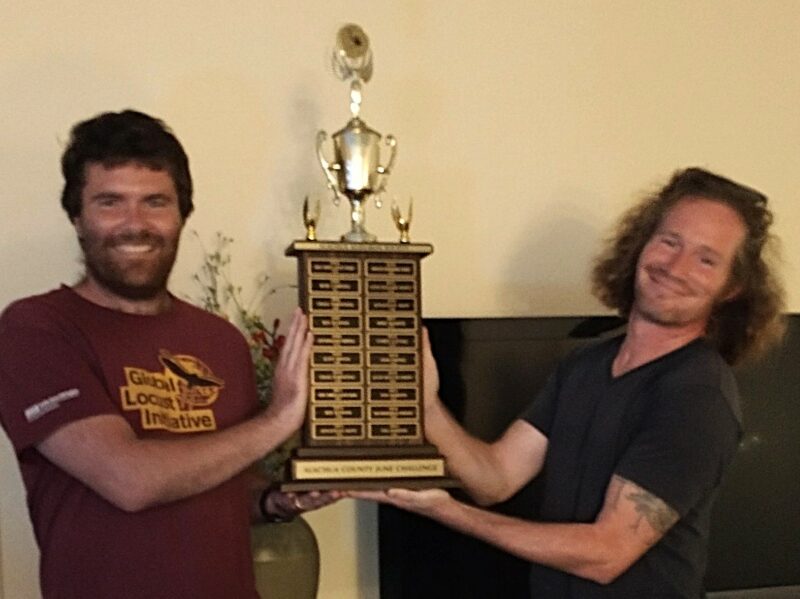
Tim Hardin (left) and Jose-Miguel Ponciano shared the first place prize – possession of the trophy!

There was a real spirit of adventure in this year’s June Challenge, and it was as much fun to watch as it was to participate in. Tim Hardin had told me in May that he wasn’t planning to push so hard this year, and might even take mid-June off, so to speak, but once in the event he couldn’t help himself. This was probably due to the unrelenting competition he faced, mainly from Jose Miguel Ponciano, a UF biology professor who has rediscovered the joy of birding after 20 years absorbed in math and statistics, and Chris Cattau, a 19th-century explorer-naturalist who has somehow found himself transported into the 21st century, where he works as an ecologist. These and other hard-charging birders seemed to find something new and rare every day, and you could either keep up with them or they’d leave you behind. Birders chasing one rarity invariably seemed to find another. Chris found Black Terns on Newnans Lake and while looking for the Black Terns, Tim found Least Terns and Chris found a Common Loon, and the search for these turned up Common Terns, and so on. The energy and enthusiasm generated by all these rarities was enough to inspire the renting of boats on Lake Santa Fe and Newnans Lake, and the launching of canoes and kayaks at Newnans, Lochloosa, and Orange. It was a veritable birding navy! When the dust cleared, Jose Miguel and Tim had tied for first place with 129, and Chris had come in third with 124. This was Jose Miguel’s first June Challenge. It was Tim’s fourth, but he’s won first place, or tied for first, in the last three of them. They didn’t just win Alachua County, either. They won the state, with the highest total of all 68 birders who submitted a list to the FWC site: https://floridabirdingtrail.com/2022-june-challenge-results/

Alachua County birders recorded 132 species this June, and of these Tim and Jose Miguel saw 98%. That may be the highest percentage ever recorded in the Challenge’s history. There were some good birds. Brown Pelicans showed up not just once but three times, at Orange Lake, at Lake Santa Fe, and at Newnans Lake. Ring-necked Duck was found at both Barr Hammock and Orange Lake. Belted Kingfishers were seen in six different places, and Yellow-crowned Night-Herons were almost as common. Five species of migratory shorebirds were recorded, including an early-record Spotted Sandpiper at Powers Park on June 30th. Two species of migratory warblers dropped in at the end of the month, a Louisiana Waterthrush at O’Leno and three Black-and-white Warblers, two at San Felasco Hammock and one at the Hatchet Creek Tract. And an amazing six species of terns were recorded, including the best bird of the Challenge, Common Tern. At least two Commons were at Newnans Lake, constituting the first June record for Alachua County. On the other hand, Tumblin Creek Park’s Gray Catbird – discovered by Chris in 2015 – was not found for the first time in eight years, and we missed American Robin for the first time in nine years. Wood Thrush, formerly an uncommon nesting bird at San Felasco and in northwest Gainesville, continues to be missing in action; it was last reported in a remote part of San Felasco on the 2013 Challenge.

We fielded 44 participants this year, about the same as last year. Sadly, we had no entries in the under-16 category. Of the 44, twenty saw 100+ species. Of course the point of The June Challenge is not to win, or to get a big list; the point is to have fun, to get out in the fresh air and sunshine and to see some beautiful birds, and I hope every participant considers himself or herself a winner in that respect.

Thanks for playing! I’ll be back in touch next May!

Rex Rowan

Here are the final standings (in the event of a tie, names are listed alphabetically):

Tim Hardin 129, Jose Miguel Ponciano 129, Chris Cattau 124, Roxy Ohanyan 121, Raci Ulusoy 117, Pelin Karaca 116, Anne Casella 113, Stephanie Hornbuckle 111, Bob Carroll 109, Tina Greenberg 109, Glenn Israel 109, Rex Rowan 109, Debbie Segal 109, Marie Zeglen 107, Howard Adams 104, Eric Link 104, Brent Henderson 103, Becky Enneis 102, John Martin 102, Meredith Kite 101, Hanna Radcliffe 98, Danielle Zukowski 98, Brad Hall 96, Maggie Paxson 96, Darrell Hartman 95, Sue Hartman 95, Wendy Seale 94, Barbara Shea 94, Matt Hitchings 92, Matt Bruce 88, Erin Kalinowski 87, Jason Chen 84, Linda Holt 84, Bob Knight 83, Tom Wronski 83, Ellen Frattino 80, Austin Gregg 80, Jen Munley 80, Rick Wolf 79, Sara Palmi  76, Oscar Calinescu 74, Eric Amundson 71, Pratibha Singh 65, Autumn Rose 62.

And here’s the complete list of the 132 bird species reported during this year’s Challenge:

  • Black-bellied Whistling-Duck
  • Canada Goose
  • Muscovy Duck
  • Wood Duck
  • Blue-winged Teal
  • Mallard
  • Mottled Duck
  • Ring-necked Duck
  • Northern Bobwhite
  • Wild Turkey
  • Pied-billed Grebe
  • Rock Pigeon
  • Eurasian Collared-Dove
  • Common Ground Dove
  • White-winged Dove
  • Mourning Dove
  • Yellow-billed Cuckoo
  • Common Nighthawk
  • Chuck-will’s-widow
  • Chimney Swift
  • Ruby-throated Hummingbird
  • King Rail
  • Common Gallinule
  • American Coot
  • Purple Gallinule
  • Purple Swamphen
  • Limpkin
  • Sandhill Crane
  • Whooping Crane
  • Black-necked Stilt
  • Killdeer
  • White-rumped Sandpiper
  • Semipalmated Sandpiper
  • Spotted Sandpiper
  • Solitary Sandpiper
  • Greater Yellowlegs
  • Laughing Gull
  • Least Tern
  • Caspian Tern
  • Black Tern
  • Common Tern
  • Forster’s Tern
  • Royal Tern
  • Common Loon
  • Wood Stork
  • Anhinga
  • Double-crested Cormorant
  • American White Pelican
  • Brown Pelican
  • Least Bittern
  • Great Blue Heron
  • Great Egret
  • Snowy Egret
  • Little Blue Heron
  • Tricolored Heron
  • Cattle Egret
  • Green Heron
  • Black-crowned Night-Heron
  • Yellow-crowned Night-Heron
  • White Ibis
  • Glossy Ibis
  • Roseate Spoonbill
  • Black Vulture
  • Turkey Vulture
  • Osprey
  • Swallow-tailed Kite
  • Cooper’s Hawk
  • Bald Eagle
  • Mississippi Kite
  • Snail Kite
  • Red-shouldered Hawk
  • Broad-winged Hawk
  • Short-tailed Hawk
  • Red-tailed Hawk
  • Barn Owl
  • Eastern Screech-Owl
  • Great Horned Owl
  • Burrowing Owl
  • Barred Owl
  • Belted Kingfisher
  • Red-headed Woodpecker
  • Red-bellied Woodpecker
  • Downy Woodpecker
  • Northern Flicker
  • Pileated Woodpecker
  • American Kestrel
  • Great Crested Flycatcher
  • Eastern Kingbird
  • Eastern Wood-Pewee
  • Acadian Flycatcher
  • White-eyed Vireo
  • Yellow-throated Vireo
  • Red-eyed Vireo
  • Loggerhead Shrike
  • Blue Jay
  • American Crow
  • Fish Crow
  • Carolina Chickadee
  • Tufted Titmouse
  • Northern Rough-winged Swallow
  • Purple Martin
  • Barn Swallow
  • Brown-headed Nuthatch
  • Blue-gray Gnatcatcher
  • Carolina Wren
  • Brown Thrasher
  • Northern Mockingbird
  • European Starling
  • Eastern Bluebird
  • House Sparrow
  • House Finch
  • Bachman’s Sparrow
  • Eastern Towhee
  • Yellow-breasted Chat
  • Eastern Meadowlark
  • Orchard Oriole
  • Red-winged Blackbird
  • Brown-headed Cowbird
  • Common Grackle
  • Boat-tailed Grackle
  • Louisiana Waterthrush
  • Black-and-white Warbler
  • Prothonotary Warbler
  • Common Yellowthroat
  • Hooded Warbler
  • Northern Parula
  • Pine Warbler
  • Yellow-throated Warbler
  • Summer Tanager
  • Northern Cardinal
  • Blue Grosbeak
  • Indigo Bunting

Interested in an AAS Internship?

Alachua Audubon Society seeks individuals interested in conservation, education, NGO administration, fundraising and other conservation activities. Interns must be currently matriculated college students in good academic standing and be able to contribute a minimum of 5 hours per week for at least 12 weeks during a regular academic term. Intern opportunities we anticipate in Spring 2022 include design of educational materials (graphic arts), helping with field trips and birding classes for the public/kids, organizing guest speakers, mist netting / bird banding training for educational functions, and strategic social media. Interns may accrue academic credit if arranged by their institution.

QUALIFICATIONS:
 Undergraduate student, actively registered during the 2021/2 academic year
 Interested in conservation, knowledgeable or enthusiastic about birds
 Must have 5 hours per week (including weekends) for activities with AAS staff
APPLICATION: Electronic submission (PDF in email) should include:
 letter of intent,
 latest resume with contact information,
 list of 3 references who agree to be contacted (w/phone numbers) (at at least one needs to be a college professor)
all in one single PDF file.

EMAIL APPLICATIONS TO: CHUCAO@UFL.EDU
 by Jan 7, 2022, 5 PM.
 Put AAS INTERN in the subject line.

If you have already served as an intern with us and you want to serve again – re-apply!