Birding the New Year in

From: Rex Rowan <rexrowan@gmail.com>
To: Alachua County birding report

Remember that Alachua Audubon leads a Sweetwater Wetlands Park walk every Wednesday morning. We’ll meet at the shelter just off the parking lot at 8:30 a.m. on January 6th for the first Wednesday Wetlands Walk of 2016.

Also, mark your calendars for Adam and Gina Kent’s talk on “Imperiled Birds of Central Florida” next Tuesday, January 12th. More details here: https://alachuaaudubon.org/programs/

The Brown Creeper found at the Tuscawilla Prairie on the Christmas Count is still there, though it’s mostly hanging around the parking lot at the Native American Heritage Preserve north of the road. Dalcio Dacol posted an excellent photo in his eBird checklist from the 4th: http://ebird.org/ebird/view/checklist?subID=S26674039

The Vaux’s Swifts are still here, though they’re not perfectly reliable. Visiting Clay County birder Steve Raduns reported 16 on the 2nd, but Mike Manetz didn’t see any between 4:30 and dark on the 3rd. On the 4th, however, they were back, and visiting Tennessee birder Thomas McNeil posted the following note on his eBird checklist: “Appeared overhead at 5:47 pm. They circled for a few minutes and dropped into the right chimney. I attempted cellphone videos. The phone playback of the two separate videos appears to show 17 birds going into the chimney (although I could have missed a bird coming back out). My wife counted 16 (don’t ever argue with your wife).”

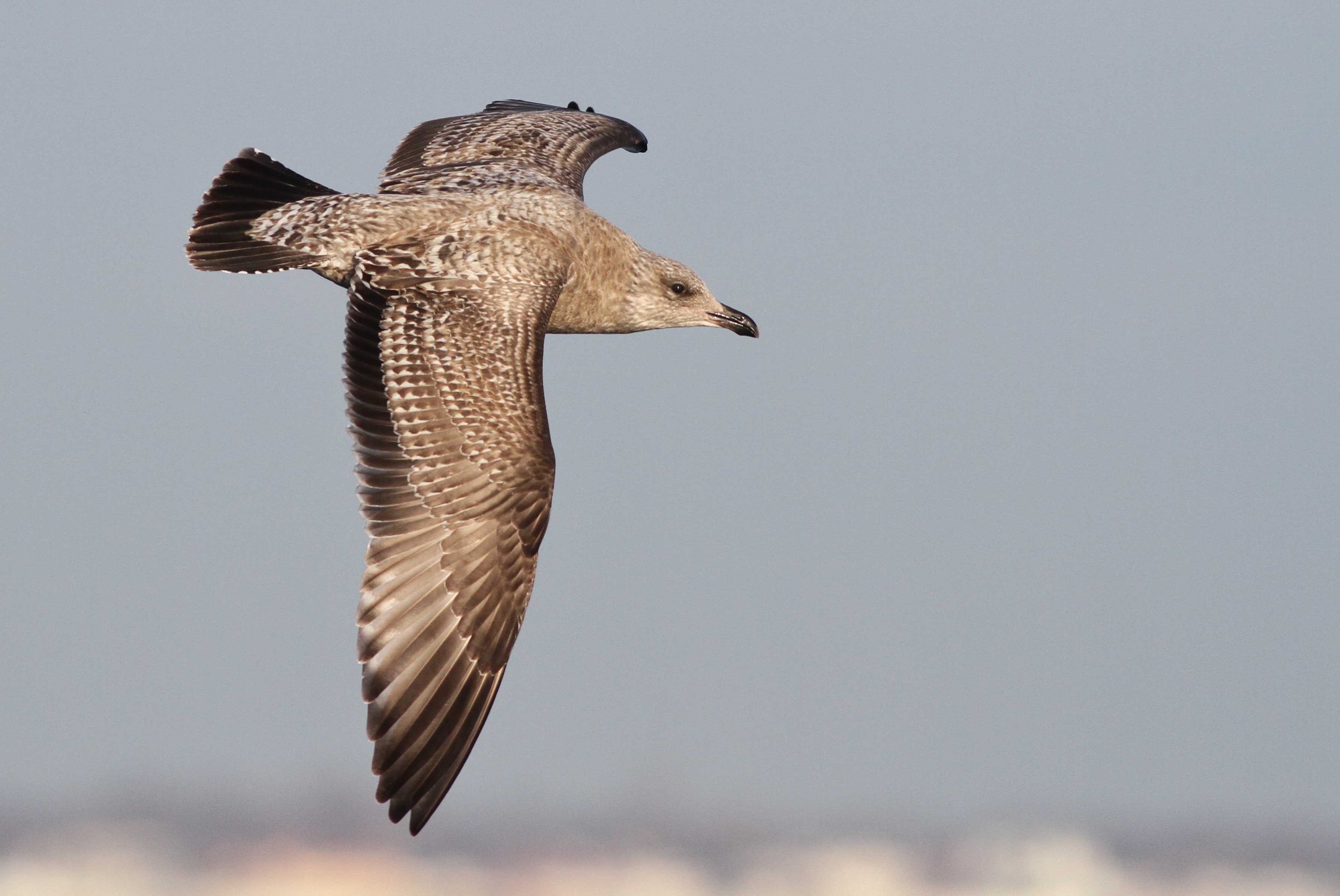
On the 2nd, writes Bob Carroll, “I spent a delightful 90 minutes in a slight, on-again off-again drizzle at Palm Point from about 4:00 to about 5:30. The delightful part had a lot to do with about 40 Bonaparte’s Gulls that spent the entire time just off the Point feeding from right to left and then circling back. They were fun to watch. Periodically another group of larger gulls circled in to check out the activity. Most were Ring-billed Gulls, but there were also at least one Laughing Gull and one Herring Gull among them. Then just about 5:15 another gull flew over that I believe was the Lesser Black-backed Gull. Fortunately, it circled for a couple of minutes before heading north. Everything I saw matched the photos you’ve posted, especially the pale ring on the nape, the extensive black on the upper wings, black bill, wide black band at the end of the tail and what seemed to be a smudgy rump. Because of the rain, I didn’t have my camera out, so I got no photos. Still, I’ve never had a five-gull day in Alachua County, so it was a great way to start the year.”

Harry Jones saw two American Redstarts at Bolen Bluff on the 4th, as well as a Wilson’s Warbler. The Wilson’s is the fifth of the winter; Adam Zions had two at Cones Dike on the 2nd, there’s been one at Chapmans Pond since the 14th, and Scott Robinson saw one at Kanapaha Botanical Gardens on the CBC. And at least one Nashville Warbler is still hanging around the west side of Chapmans Pond, seen most recently on the 4th by Lloyd Davis. Mike Manetz got a couple of photos on the 2nd and embedded them in his eBird checklist: http://ebird.org/ebird/view/checklist?subID=S26609816

Summer Tanagers are wintering around Gainesville in unprecedented numbers. Just for the sake of comparison, between 1969 and 2005 a grand total of 13 or 14 Summer Tanagers were reported wintering in Gainesville. That’s 13 or 14 over the course of 46 winters – whereas 11 or 12 were reported in the past month!

Sandhill Crane numbers were pretty low on the Christmas Bird Count, but maybe that’s because most of the birds were dawdling up north. On the afternoon of the 1st Ron Robinson saw several groups flying south over his place at the western edge of Gainesville, and on the 2nd Donny Griffin saw cranes going over the Osceola National Forest. If these birds are just now arriving, it’s by far the latest fall migration I’ve ever heard about.

By contrast, it’s my impression that Cedar Waxwings are early this winter. Normally they start building up in January and peak from February through April. But they’re already being seen in large numbers all across town. Sam Ewing saw a flock of 1,000 near Shands Hospital on the 3rd.

We’ve got some unfinished 2015 business to attend to. First, fourteen birders tallied 200 or more species in Alachua County in 2015:

Mike Manetz 240 (ties the fourth-highest total ever; Mike also owns first place, with 255 in 2012, and he’s twice gotten 241, once in 2000 and again in 2013)
John Hintermister 232 (sixth-highest total ever)
Rex Rowan 225
Adam Zions 224
Lloyd Davis 223
Debbie Segal 217
Matt O’Sullivan 213
Howard Adams 210
Trina Anderson 209 (tie)
Sam Ewing 209
Andy Kratter 204
Jennifer Donsky 203
Jonathan Mays 202
Barbara Shea 201

Congratulations, all! And we’re off to a good start in 2016, with Lloyd Davis and Adam Zions vying for first place with 83 species each as of the 3rd.

Among Alachua County birders, here are the ten largest Florida state year lists for 2015:

Lloyd Davis 304 (tie)
John Hintermister 304
Adam Zions 303
Mike Manetz 287
Jonathan Mays 277 (three-way tie)
Matt O’Sullivan 277
Debbie Segal 277
Phil Laipis 272 (tie)
Charlene Leonard 272
Adam Kent 267

Every year Adam Zions comes up with his list of Top Ten Birds of the Year. Here’s this year’s edition. Take it away, Adam:

Another year has passed and the earth has nearly made another complete revolution around our brightest source of light. You know what it means. Time to figure out the Top 10 Most Intriguing Birds observed in Alachua County for 2015. And here I thought recent years proved difficult to determine this list. 2015 may yet be the most difficult year for me since I’ve moved up here.

Here are my candidates in taxonomic order (please feel free to add any I may have overlooked):
Fulvous Whistling-Duck
Black Scoter
Purple (Gray-headed) Swamphen (for better or worse)
Red-necked Phalarope
Lesser Black-backed Gull
Groove-billed Ani
Vaux’s Swift
Alder Flycatcher
Shiny Cowbird
Bullock’s Oriole

Others which didn’t make the above list (and it speaks to how many great birds passed through the county this year), but which are nonetheless excellent observations in themselves for the county:
Greater White-fronted Goose
Red-breasted Merganser
Magnificent Frigatebird
White-faced Ibis
Whooping Crane
American Avocet
Least Tern
Vermilion Flycatcher
Ash-throated Flycatcher
Western Kingbird
The Cave and Cliff Swallow combo (right next to each other) which Mike Manetz found
Winter Wren
Canada Warbler
Lark Sparrow
Dark-eyed Junco
Western Tanager
Yellow-headed Blackbird
Bronzed Cowbird
Purple Finch

Thanks, Adam. Please submit your votes for Ten Best Birds of 2015 and I’ll post the winners in a future email.

See you at Sweetwater on Wednesday morning and at Prairie Creek Lodge for Adam and Gina’s talk on the 12th.

Christmas Bird Count results

From: Rex Rowan <rexrowan@gmail.com>
To: Alachua County birding report

On December 20th the 58th Gainesville Christmas Bird Count (or the 61st if you count CBCs performed by couples in 1924, 1927, and 1949) managed to tie the record of 162 species set in 2012. We almost beat it, because there was a possible Chestnut-sided Warbler at Lake Alice, but this was never confirmed, so 162 it is. At the end of the email I’ve posted the complete list of birds seen.

The most exciting bird seen on the count was a first-county-record Lesser Black-backed Gull found by the boat team (Andy Kratter, Peter Polshek, John Mangold, and Terry Cake) at Newnans Lake. John got a series of superb photos, two of which are linked below:

Lesser Black-backed Gull

Lesser Black-backed Gull

The Lesser Black-backed was seen from Palm Point on the 29th by Dotty Robbins, so it may be worthwhile to go out there if you haven’t seen it yet.

David and Kim Stringer live at Savannah Pointe, south of Williston Road just west of I-75. They’ve recently had hundreds of Sandhill Cranes in the fields behind their home. They write, “Folks are welcome to stop by to see or photograph. Call ahead: 352-332-6580.” Janet Jordan has been seeing a Whooping Crane at the Kanapaha Prairie, but unfortunately the Prairie is private property. However if the Whooping Crane sticks around till January 23rd, participants in Alachua Audubon’s Kanapaha Prairie field trip may get to see it.

Here’s something from David Sibley on estimating bird numbers. I should have linked to this before the Christmas Count! http://www.sibleyguides.com/2015/12/a-new-quiz-series/

Black-bellied Whistling-Duck 551
Snow Goose 1 (near Kanapaha Prairie) https://www.flickr.com/photos/thermalin/23687706960/in/dateposted/
Muscovy Duck 266
Wood Duck 191
Gadwall 15
American Wigeon 1
Mallard 12
Mottled Duck 87
Blue-winged Teal 690
Northern Shoveler 17
Northern Pintail 3
Green-winged Teal 16
Redhead 1
Ring-necked Duck 354
Lesser Scaup 60
Bufflehead 7
Hooded Merganser 98
Ruddy Duck 16
Northern Bobwhite 11
Wild Turkey 30
Pied-billed Grebe 142
Horned Grebe 31
Wood Stork 68
Double-crested Cormorant 521
Anhinga 178
American White Pelican 1
American Bittern 7
Least Bittern 4 (all at Sweetwater Wetlands Park)
Great Blue Heron (including 1 Great White Heron at Sweetwater Wetlands Park) 147
Great Egret 166
Snowy Egret 216
Little Blue Heron 374
Tricolored Heron 87
Cattle Egret 93
Green Heron 17
Black-crowned Night-Heron 103
White Ibis 2,865
Glossy Ibis 154
Black Vulture 426
Turkey Vulture 983
Osprey 6
Northern Harrier 44
Sharp-shinned Hawk 12
Cooper’s Hawk 7
Accipiter, sp. 2
Bald Eagle 75
Red-shouldered Hawk 190
Red-tailed Hawk 48
King Rail 10
Virginia Rail 11
Sora 60
Purple Swamphen 2
Purple Gallinule 2
Common Gallinule 485
American Coot 2,892
Limpkin 66
Sandhill Crane 963
Whooping Crane 1 (flying over downtown Gainesville)
Killdeer 333
Spotted Sandpiper 2
Greater Yellowlegs 15
Lesser Yellowlegs 8
Least Sandpiper 34
Wilson’s Snipe 147
American Woodcock 10
Bonaparte’s Gull 2
Laughing Gull 1 (Newnans Lake)
Ring-billed Gull 286
Herring Gull 2 (Newnans Lake)
Lesser Black-backed Gull 1 (Newnans Lake)
Forster’s Tern 3
Rock Pigeon 77
Eurasian Collared-Dove 21
White-winged Dove 1 (near Kanapaha Prairie)
Mourning Dove 370
Barn Owl 3
Eastern Screech-Owl 12
Great Horned Owl 35
Barred Owl 50
Eastern Whip-poor-will 1
Vaux’s Swift 14 (UF campus, present since mid-November)
Ruby-throated Hummingbird 1 (NW Gainesville)
Belted Kingfisher 36
Red-headed Woodpecker 15
Red-bellied Woodpecker 304
Yellow-bellied Sapsucker 111
Downy Woodpecker 118
Northern Flicker 64
Pileated Woodpecker 124
American Kestrel 44
Merlin 2
Least Flycatcher 2 (Cones Dike Trail)
Eastern Phoebe 453
Ash-throated Flycatcher 2 (Persimmon Point at Paynes Prairie)
Loggerhead Shrike 26
White-eyed Vireo 101
Blue-headed Vireo 103
Blue Jay 260
American Crow 609
Fish Crow 107
crow, sp. 140
Tree Swallow 170
Northern Rough-winged Swallow 1 (Cones Dike Trail)
Carolina Chickadee 232
Tufted Titmouse 359
Brown-headed Nuthatch 6
Brown Creeper 1 (Tuscawilla Prairie)
House Wren 177
Sedge Wren 60
Marsh Wren 69
Carolina Wren 395
Blue-gray Gnatcatcher 493
Ruby-crowned Kinglet 627
Eastern Bluebird 245
Hermit Thrush 54
American Robin 1,143
Gray Catbird 145
Northern Mockingbird 168
Brown Thrasher 15
European Starling 24
American Pipit 2
Cedar Waxwing 410
Ovenbird 6
Northern Waterthrush 7 (Cones Dike Trail)
Black-and-white Warbler 106
Orange-crowned Warbler 104
Nashville Warbler 1 (Chapmans Pond)
Common Yellowthroat 191
American Redstart 1 (Kanapaha Gardens)
Northern Parula 7
Palm Warbler 758
Pine Warbler 221
Yellow-rumped Warbler 2,111
Yellow-throated Warbler 50
Prairie Warbler 7
Black-throated Green Warbler 1 (west side of Paynes Prairie)
Wilson’s Warbler 2
Eastern Towhee 97
Chipping Sparrow 593
Field Sparrow 9
Vesper Sparrow 14
Savannah Sparrow 60
Grasshopper Sparrow 1
Henslow’s Sparrow 4
Fox Sparrow 2 (Prairie Creek Preserve)
Song Sparrow 32
Lincoln’s Sparrow 3
Swamp Sparrow 233
White-throated Sparrow 8
Summer Tanager 1 (NW Gainesville)
Western Tanager 1 (NW Gainesville)
Northern Cardinal 627
Indigo Bunting 1 (Chapmans Pond)
Painted Bunting 4
Red-winged Blackbird 5,857
Eastern Meadowlark 169
Rusty Blackbird 3
Common Grackle 86
Boat-tailed Grackle 948
Brown-headed Cowbird 840
Baltimore Oriole 49
House Finch 94
American Goldfinch 451
House Sparrow 22

Lesser Black-backed Gull at Newnans Lake!

From: Rex Rowan <rexrowan@gmail.com>
To: Alachua County birding report

During yesterday’s Christmas Bird Count the Newnans Lake boat team (Andy Kratter and John Mangold with Terry Cake in Terry’s boat) discovered a first-winter Lesser Black-backed Gull, a bird never before seen in Alachua County. John got photos from the boat, but I don’t think they’re available yet. Anyway, John Hintermister, Phil Laipis, Mike Manetz, Greg McDermott, and I assembled at 7:30 this morning at the Windsor boat ramp (Owens-Illinois Park) in hope of seeing it. Perhaps “hope” is not the word, since John was the only one of us who was optimistic about our ability to identify a distant immature gull through spotting scopes. In fact, Mike was so skeptical about our chances that he almost stayed home. But we found it, and (to everyone’s surprise but John’s) it was actually identifiable at long distance, so it might be worthwhile to give it a try yourself.

I expected a big warm brown gull, like a first-year Herring Gull. But the brown tones on this bird are a darker, “colder” brown, almost sooty. The head and neck look white from a distance, the bill all black. There’s a dusky area, a “mask,” around the eye. In flight the wings look quite dark both above and below. The rump is white. Here are a couple of photos taken from the internet that will give you an idea of what you’re looking for:

Resting, as when floating on the water: http://www.nemesisbird.com/wp-content/uploads/2015/01/IMG_3303.jpg

In flight: http://www.nemesisbird.com/wp-content/uploads/2013/11/lbbg2.jpg

After we’d seen the bird, I had to head home – my son had bought tickets for a 10:45 showing of the new Star Wars movie – but the others went on to the Tuscawilla Prairie, where a Brown Creeper was found yesterday by the Christmas Bird Count team in the wooded area north of the marsh. It was found today as well, by John, Phil, Mike, and Greg. Mike wrote that it was “first heard making its high-pitched single-note call.”

Come on over baby, whole lotta Purple goin’ on!

From: Rex Rowan <rexrowan@gmail.com>
To: Alachua County birding report

On November 20th I had an email from Karen Burkhardt, telling me that she’d gotten her life Purple Swamphen at Sweetwater Wetlands Park that day. As an afterthought she added, “there are actually two Swamphens at Sweetwater.” I was surprised to hear that, and, okay, maybe a little skeptical, so I queried her further. Had they been seen together? “Yes, by multiple observers,” she replied. “The were having a ‘domestic dispute’ so there was no question about it.” I inquired whether anyone had obtained a photo, and reminded her that Purple Gallinules can look something like Purple Swamphens. She bristled at that: “The ‘domestic dispute’ was observed by others. The other bird was not, not a Purple Gallinule. That’s all I have to say about it.”

She was right. Today I heard from Frank Goodwin and David and Kim Stringer that they’d seen two swamphens at Sweetwater, and Frank sent a photo to prove it: https://www.flickr.com/photos/74215662@N04/23057907593/in/dateposted-public/

Two. You know what that means. The name of the park will soon be Swamphen Wetlands Park.

On the 10th an Alachua County birder looked out the window and saw this at his feeder: https://www.flickr.com/photos/74215662@N04/23576435102/in/dateposted-public/ It was still there today. In case you don’t know what that is, it’s a female Purple Finch, a bird of the northern coniferous forests that only comes this far south occasionally. But the presence of one here suggests that we should all start watching our feeders a little more closely.

Purple Swamphen, Purple Finch. You can see I’m working a theme today. How about this, then: a Purple Swamphen standing next to a Purple Gallinule, courtesy of Chris Janus: https://www.flickr.com/photos/chris_f8/22943435884/in/dateposted/

Here’s a bird photo quiz to get you in the right frame of mind for the Christmas Bird Count. You can’t play if you subscribe to this particular photographer’s Flickr page and have seen it before. I’ll tell you only that it was taken in Gainesville on December 6th and that, for once today, the word “purple” is not part of its name. What bird is it, and why do you think so? https://www.flickr.com/photos/74215662@N04/23274393999/in/dateposted-public/

Every year my sisters ask what I want for Christmas, and every year I don’t know what to tell them. You’ve got the same problem, right? You already have the Aston Martin golf cart, the 14-foot hi-def TV, and the $3,000 hamster-lined socks; and last year your best friend arranged for Taylor Swift and Yo Yo Ma to perform the Beatles’ songbook in your living room while Mary Elizabeth Winstead sat on your knee and reprised her Ramona Flowers character from “Scott Pilgrim vs. the World.” After setting the bar that high, what on earth can they get you this year? They can get you A Birdwatcher’s Guide to Alachua County, Florida, the greatest bird book ever written! Roger Tory Peterson was just a lonely sailor until he stumbled across a copy of A Birdwatcher’s Guide to Alachua County, Florida, and ten years later he published A Field Guide to the Birds. David Sibley was eking out a living repairing rubber bands in Mississippi when someone sent him a copy of A Birdwatcher’s Guide to Alachua County, Florida, and five years after that he published The Sibley Guide to Birds. No doubt you’ve heard what happened to sanitation worker Bill Gates, dental hygienist Lebron James, and human resources specialists Taylor Swift and Yo Yo Ma when they happened across copies of this astonishingly helpful and inspirational book! 128 pages, 42 maps, descriptions of 52 birding spots, accounts of each of the county’s 340 extant bird species as of May 2006. It will transform your life! Or at least help you to see more birds, and entertain you along the way. You can find it at Wild Birds Unlimited, which is right next door to The Flying Biscuit in the shopping center at NW 43rd Street and NW 16th Boulevard. Your problem is solved; you can get on with your life. Whew! You’re welcome!

Black Scoter, Vaux’s Swifts, Purple Swamphen still there

From: Rex Rowan <rexrowan@gmail.com>
To: Alachua County birding report

Bob Carroll says the male Black Scoter was in view from Owens-Illinois Park (AKA the Windsor boat ramp) at 11:00 this morning. Yesterday afternoon there were nine, eight females and a male. Eight of the birds were at the far northern end of the lake, one a little closer. John Hintermister also saw a Red-breasted Merganser out there yesterday.

The Vaux’s Swifts are still being seen at Dauer Hall. Murray Gardler got a great photo of six swifts descending into one of the chimneys on the 2nd. And on the 1st Jonathan Mays got video of three going down the chimney like little gray Santa Clauses while eight more sped past in the background.

On the morning of the 2nd Mike Manetz and Matt O’Sullivan went in search of the Dickcissel and Yellow-headed Blackbird seen at the Hague Dairy on the 28th. They didn’t see either – no one has, since the 28th – but they did find an Ash-throated Flycatcher, which Matt photographed: https://www.flickr.com/photos/118053703@N02/23505222965/in/dateposted/ As you enter the dairy property from County Road 237, the first pond you come to, just past the concrete feeding troughs on the right, is so heavily vegetated around the edges that you can’t actually see the pond. That’s where they found the flycatcher.

The Purple/Gray-headed Swamphen was in its usual place on the 3rd. It’s the best kind of bird, one that always stays in the same place and stands right out in the open so that birders can see it. On the 30th Dotty Robbins and Emily Schwartz went to see the swamphen and found something even better: “Right before we got to the water control structure, a small dark bird flew from the near edge of vegetation across the open water into the thick veg and disappeared. It flew about 20 feet. It was around noon, and the light was glarey. The bird appeared dark, rail-shaped, like a Sora but smaller. What I noticed most was the very clearly defined white patches on the trailing edge of the secondaries. I immediately thought Yellow Rail. But the bird appeared almost black–maybe a result of the light. Does any other rail-like bird show that white patch on the secondaries? If not, this was a Yellow Rail. To be clear about the location, we started our walk by heading to the right, so we were approaching the water structure from the west.” This is only the ninth or tenth report of Yellow Rail in Alachua County.

Carol Foil writes to announce the first Putnam County Christmas Bird Count: “Joyce King and I have got together with the State Park people and decided that Putnam County needs a CBC! We are just aiming to do an unofficial test run this year. We have chosen Sunday, January 3 for our date. The center of the circle will be in Satsuma. The circle will encompass the new jewel soon-to-open Dunn’s Creek State Park, Ravine Gardens State Park including their riparian bottom lands, Welaka State Forest, lower Ocklawaha R, middle St John’s River from Little Lake George to East Palatka, Dunn’s Creek, top of Crescent Lake, Rodhever Boys Ranch, Caravel, Rodman Lock and Dam. We will have at least one boat party. Should be fun, but we need at least 7 teams to cover all this. We plan to partner birders with Park and Forest Rangers and local naturalists who know the trails. We wonder if you could post a ‘save the date’ to Alachua Audubon and tell anyone who is intrigued to email us at Cbcputnam@gmail.com .”

Other local Christmas Counts planned for this month include Melrose on the 17th, Gainesville on the 20th, Ichetucknee/Santa Fe/O’Leno on the 22nd, Cedar Key on the 30th, and Lake City on January 2nd.

Remember the Alachua Audubon Society’s 9th Annual Holiday Social and Silent Auction is tonight from 6:30 to 9:00 at the Mill Pond Clubhouse, 240 NW 48th Blvd.

Santa Fe Audubon in Melrose is starting its own tradition this year with a Conservation Celebration and Silent Auction on December 8th. It’s going to be quite a do, with a chili and cornbread dinner, live music, and a program called “John J. Audubon Speaks” with Michael Adams portraying the great American wildlife painter. It will be held at Trinity Episcopal Church’s parish hall between 6:00 and 9:00 p.m. Everyone is invited. For more information contact Joyce King at sjoyceking@comcast.net . Visit Santa Fe Audubon’s web site here: http://www.santafeaudubon.org/pages/activitiesAll.aspx

Hague’s a-hoppin’! plus Vaux’s Swift update

From: Rex Rowan <rexrowan@gmail.com>
To: Alachua County birding report

Cole Fredericks of Winter Haven saw both the Purple Swamphen (“Gray-headed Swamphen” in eBird) and the Fulvous Whistling-Duck on the 29th. Can’t guarantee that we’ll see them on this week’s Wednesday Wetlands Walk, but we’ll look. The walk starts at 8:30 a.m. Admission to the park is $5 per vehicle. Here’s a nice picture of the swamphen by Jerry Pruitt: https://www.flickr.com/photos/74215662@N04/23268690302/in/dateposted-public/

The Hague Dairy was hopping on the 28th. Andy Kratter kicked things off when he heard the call note of a Dickcissel: “It was initially in the parking area, but Adam Zions saw it along the entrance drive after I left. It was hanging out with Chipping Sparrows and Palm Warblers [near the concrete cattle troughs a hundred yards in from County Road 237]. I also found a Pine Siskin and a Northern Parula. Adam found the Yellow-headed Blackbird after I left.” I tried to relocate those birds on the 29th with Jacksonville’s Kevin Dailey and two friends, but we failed to find anything but the Northern Parula. We did see one or two Blue Grosbeaks, plus a Western Kingbird, by the concrete troughs. The kingbird may be the same one recorded at the dairy several times between the 13th and the 19th. Kevin’s eBird checklist contains a photo: http://ebird.org/ebird/view/checklist?subID=S26046891

(In case you didn’t know, Hague was named for the community’s first postmaster, Archelaus Hague. They don’t make postmasters like that anymore!)

Vaux’s Swift update: At about 5:00 p.m. on the 27th I sat down on a little wall in front of Pugh Hall that gave me a good view of the Dauer Hall chimneys. At 5:34 a flock of fourteen swifts appeared flying south over the roof of Dauer. They circled for a couple of minutes, and then eleven fluttered down into the right chimney, one by one in quick succession, at 5:36. The other three went out of sight then reappeared and went into the left chimney at 5:38. So it was only four minutes between appearance and disappearance. I thought I heard a moment’s vocalization, which agreed with Vaux’s but not Chimney. The wings struck me as shorter than Chimney’s, the wing beats more rapid, which are also traits of Vaux’s Swift.

At least one Nashville Warbler was at Chapmans Pond every day from the 21st through the 27th, with two individuals seen periodically between the 22nd and the 25th. The birds may still be there. Look for them in the brush and small trees growing along the fence at the west end of Chapmans Pond (under the power lines). A male Vermilion Flycatcher was reported there on the 24th by Ocala’s Doug Richard, so keep your eyes open.

Cedar Waxwings are a little early this winter. Geoff Parks had the season’s first, a single bird in a flock of robins, on the 11th, and waxwing flocks have been reported here and there around Gainesville during the past week – mostly small groups of 10-25 birds, but Debbie Segal reported a flock of 80 at Barr Hammock’s Levy Loop Trail on the 27th.

It used to be that winter kingbird roosts were a South Florida thing – Lake Okeechobee and points south – but over the past couple of decades they’ve been creeping northward. Now a Scissor-tailed Flycatcher and up to 7 Western Kingbirds have been wintering in Ocala since early November, the Scissor-tailed and two Westerns at the Ocala Regional Sportsplex and along the adjoining stretch of SW 38th Street, and up to five Westerns at the Big Sun Soccer Complex (both locations are easily Googled). Here’s an eBird checklist from Dorothy Dunlap, featuring photos of the Scissor-tailed and two Westerns: http://ebird.org/ebird/view/checklist?subID=S26042913

Alachua Audubon’s 9th Annual Holiday Social and Silent Auction is coming up this Friday, December 4th, from 6:30 to 9:00 pm at the Mill Pond Clubhouse at 240 NW 48th Blvd. Celebrate conservation, birds, and the holidays with the Alachua Audubon Society! This festive event will include hors d’oeuvres, beverages, and a silent auction—one of our important annual fund raising events. The holiday party will be held at the Mill Pond Clubhouse. Directions: From Newberry Road, turn south on NW 48th Blvd (across from Gainesville Health and Fitness Center). Drive south about 2 blocks. Look for tennis courts on the right. The Clubhouse is next to the tennis courts on the right. Look for our Alachua Audubon signs! We look forward to seeing you at our upcoming Holiday Social!

Swift roost found, Yellow-headed Blackbird at Hague Dairy

From: Rex Rowan <rexrowan@gmail.com>
To: Alachua County birding report

John Hintermister found a Yellow-headed Blackbird at the Hague Dairy at about lunchtime today. That’s the third of the fall.

There’s a scene in “True Grit” where Rooster Cogburn, impressed with the persistence and daring of Mattie Ross, declares, “She reminds me of me!” I’d like to say that about Sam and Ben Ewing, but I was never half as intrepid as they are. Sam wrote on the 25th, “Ben and I climbed to the top of the stadium this evening to watch the skyline for swifts. Around 5:15 the first swift showed up and flew all over the place for a while. It finally began circling between the stadium and Century Tower, and finally dropped down into a chimney. We could not see exactly where, so we hurried to the tip top of the stadium, and spotted eleven more swifts flying around. We watched them, and spotted them go down a chimney a few buildings over. We first figured out where it looked to be on a satellite map, and then biked over and confirmed the location – they are roosting in the double chimney at Dauer Hall, right next to Pugh Hall. All twelve seemed to go into the same chimney, the first going in probably shortly after 5:20, and the rest going in around 5:30 or shortly after. I don’t know if we will make it out there tomorrow night or not, but staking out directly below the chimney should yield a positive identification.” Sam and Ben and Matt O’Sullivan went back to Dauer Hall the next evening: “We saw a minimum of fourteen swifts enter the chimney between 5:30 and 5:40, but unfortunately they were all silent. After they all went in, individual birds kept flying out one at a time, circling, and then going back in. The last one did that at about 5:54. I guess we will just have to continue staking the location out, and hope for vocalizations.”

The Gray-headed Swamphen was seen daily from the 19th through the 22nd and then disappeared, but luckily it was just taking a little break. It was seen yesterday and today in the same spot where it was found, at the water control structure on the far (south) side of Cell 1. Unfortunately the Fulvous Whistling-Duck hasn’t been seen since the 22nd, when Pete Hosner photographed it: http://ebird.org/ebird/view/checklist?subID=S25948405

I hope everyone had a Happy Thanksgiving!

Possible Vaux’s Swifts in Gainesville, plus Nashville Warblers persisting

From: Rex Rowan <rexrowan@gmail.com>
To: Alachua County birding report

On the evening of November 22nd Sam Ewing emailed, “I am almost sure I just saw some Vaux’s Swifts over NW 8th Avenue. There were at least a dozen swifts flying around overhead, disappearing and reappearing, so it was hard to know how many. I heard some odd calls (almost bat-like) and both times it seemed to be the swifts. After listening to the calls of Vaux’s Swifts at home, I am nearly certain that at least one or two of the swifts, possibly all, were Vaux’s. Again, I could be wrong, but it is worth checking into, I think. I will probably go back tomorrow evening. They seem to sort of congregate over 8th Avenue, but there is so much traffic noise that hearing them is difficult when they do vocalize. 8th Avenue does give you the best view of the sky though, so it is hard to know where the best place to go would be.”

On the 23rd Mike Manetz and I joined Sam and his brother Ben to watch for swifts on 8th Avenue near the boardwalk a quarter mile west of the hill (or two-thirds of a mile east of 34th Street). We saw only one – it came and went quickly and did not vocalize – but it would be worth keeping an eye on the sky from about 4:30 or 5:00 onward, especially if you live in the vicinity of Loblolly Woods or the UF campus. Chimney Swifts have often roosted at J.J. Finley, which isn’t too far away from where we were standing; I wonder if these swifts could be headquartered there.

If these are Vaux’s Swifts – “Vaux’s” rhymes with “foxes,” by the way, it’s not pronounced “voze” – then this is the ninth winter during which they’ve been seen in Alachua County. They were first reported here in December 1982, were almost annual from 1992-97, and were last seen ten winters ago. When they show up, they sometimes stick around for weeks or even months (for instance, late December to mid-March in 1995-96).

The Nashville Warblers – and yes, that was a plural, there are two of them – are still at Chapmans Pond as of this morning. Matt O’Sullivan’s checklist offers a nice photo (click on it for an enlargement): http://ebird.org/ebird/view/checklist?subID=S25953572

I notice that Franklin’s Gulls are still being seen along both coasts of Florida. With the passage of that cold front this past weekend, a Franklin’s might show up on any of the big lakes around here.

On the morning of the 23rd Ron Robinson saw Common Loons flying over his house west of Gainesville. Six birds passed overhead, going northeast to southwest, between 8:18 and 8:32. We often see spring-migrant loons going in the opposite direction at that time of the morning in March and April. I wonder if fall flights are as regular and predictable as spring flights.

Sandhill Cranes are arriving. David and Kim Stringer saw a flock of 150 land at the edge of Paynes Prairie on the 22nd. Sadly for us, more and more migrant Sandhills are wintering farther north, as explained in this blog post from last March: http://fieldguide.blogs.gainesville.com/19/bye-bye-birdies/

I still had two Indigo Buntings coming to my NE Gainesville feeder as late as the 23rd.

The Home Depot Pond has been fairly low recently. Three weeks ago (October 30th) I counted the birds there – as well as my limited time would permit, anyway – and came up with 7 Muscovy Ducks (others no doubt hidden in the shoreline vegetation and in the Home Depot parking lot), 3 Blue-winged Teal, 2 Pied-billed Grebes, 3 Snowy Egrets, 55 Little Blue Herons (24 adults, 31 all-white juveniles), 2 Tricolored Herons, 80 White Ibis, 5 Glossy Ibis, 2 American Coots, 14+ Killdeer, 17 Greater Yellowlegs, 7 Lesser Yellowlegs, 1 Least Sandpiper, and 10+ Wilson’s Snipe. Who knows what might be there now?

Mike Manetz reports that River Rise Preserve State Park has a new entrance policy: “The outer gate by the road is open. You drive in a quarter mile to an open parking area and pay station – 5 bucks per car (or free with the annual pass). Driving down to the Rise will not be an option, with this exception: until the first of January you can drive down to the Rise for an additional two bucks. After the January 1 you will have to walk in from the parking area.”

If you’d like to subscribe to the Florida Conservation Coalition’s daily News Brief, “Florida’s best environmental reporting, editorials, and op-eds,” you can do so here: http://www.floridaconservationcoalition.org/

The Florida Ornithological Society is puzzled as to why you’re not a member, and to satisfy their curiosity they’ve designed a five-minute survey: https://docs.google.com/forms/d/1905sYBJcXAB5N416nYj2iuMgy_qTxP0VJlVvAXAAY-c/viewform

Purple Swamphen at Sweetwater Wetlands Park!

From: Rex Rowan <rexrowan@gmail.com>
To: Alachua County birding report

Andy Kratter just called to tell me that he’d spotted Alachua County’s first-ever Purple Swamphen in Cell 1 at Sweetwater Wetlands Park. Cell 1 is the cell with the boardwalk in it. From the parking lot, come straight out the walkway to Cell 1 and turn right. Andy saw the bird a hundred yards or so past the first shelter you’ll pass. He said it flew out to the middle of the cell, so it might be worthwhile to explore the boardwalk as well. The Purple Swamphen, more correctly known as the Grey-headed Swamphen, is found across southern Asia from the Middle East to Thailand. The Florida population originated with avicultural escapes in Broward County, Florida, and resisted pretty energetic efforts by FWC to exterminate them. They’re now thoroughly established in the state. Can you count it on your ABA list? Why yes you can. (In fact, I’d better get down there right now! If Mike Manetz sees this bird before I do, he’ll relegate me to third place in the Alachua County life list standings!)

No photos were taken this morning – so far – but here’s a photo from the internet to show you what Grey-headed Swamphens look like. Something like a Purple Gallinule with a parrot bill: http://1.bp.blogspot.com/-Z_HfoEELQbU/Vc3kX2JujPI/AAAAAAAAVgI/3Eex28MaTI4/s1600/Grey-headed_Swamphen.jpg

In other SWP news, the Fulvous Whistling-Duck was seen again yesterday. Mike Manetz reported, “The Fulvous was present in open water at first light, but flew into the marsh across from the end of the boardwalk at about 7:20. It reappeared for the Alachua Audubon group at about 10:00 and remained in view sitting on a small hummock for about 15 minutes, and then flew back into the marsh.” Here’s Danny Shehee’s photo from the 17th: https://www.flickr.com/photos/74215662@N04/22520194634/in/dateposted-public/