DUCK TALES

by Rex Rowan, posted to Facebook November 1, 2018

At about lunchtime on October 30th, Rob Norton discovered a drake Eurasian Wigeon at Sweetwater Wetlands Park. He passed the word, and several local birders got to see it before the day was out – including Tom Tompkins, who took the photos below. It hasn’t positively been seen since, though a bird showing one of the field marks was briefly glimpsed the next morning, flying towards Paynes Prairie.

As the name implies, Eurasian Wigeons are native to Europe and Asia. Those that stray to eastern North America – a small number every year – are presumed to originate from a breeding population in Iceland. This was only the third in Alachua County’s history. There are stories connected with the other two.

The county’s first ever was shot by Dr. A.L. Strange at Orange Lake on December 26, 1931 and mounted by a taxidermist. Robert McClanahan, a UF undergraduate compiling an official bird list for the county, tracked down the mount in 1934 – it had lost its head by then – and secured it for the museum. Unfortunately the specimen was discarded in 1962.

The county’s second, a female, was discovered by Phil Laipis at the Hague Dairy on December 22, 2004. Puzzled – the female is nondescript – he found another birder at the dairy that morning, Pat Burns, and showed it to her. Pat suspected that it might be a Eurasian Wigeon, and she notified John Hintermister, Gainesville’s most knowledgeable and experienced birder. John drove over, examined the bird, and pronounced it either an American Wigeon or an American-Eurasian hybrid. Hearing that it was either an American Wigeon, which is common, or a hybrid, which is not countable, the local birding community stayed home in droves. Except for Steve Collins, who took several photos and circulated them among British birders. They were unanimous: it was a Eurasian Wigeon, the county’s first in 73 years! But by the time the Brits notified Steve of their conclusion, the bird had flown, so no one else got to see it. John is cheerfully unrepentant of his part in this fiasco, and when reminded of it he laughs uproariously and says, “Serves you right for not going to look at it!”
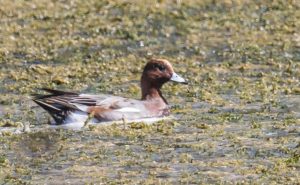
Eurasian Wigeon, courtesy of Tom Tompkins

UF killed 150 birds, records show

Read the August 18, 2018 article from the Gainesville Sun here

then continue reading below for the  two follow-up letters to the Editor.


Letters to the editor for Aug. 26, 2018

Outrageous practice

Thanks to The Sun’s investigative reporting Aug. 19 concerning lethal bird control at the University of Florida’s Citra Research Facility. Killing an iconic, threatened bird species such as the Florida sandhill crane to protect peanut research is outrageous. Instead of defending the practice, Jack Payne, director of IFAS, should apologize that his organization condoned the slaughter of at least 47 cranes and 105 ring-billed gulls.

Not included in The Sun article are the additional facts that 1) IFAS was illegally killing cranes without a state permit from the Fish and Wildlife Commission (they only had a federal permit); 2) the Florida sandhill is a state-listed threatened species whose population is declining; and 3) when originally contacted about this issue in early 2018, IFAS researchers indicated that “only a few” cranes were shot.

It is imperative that any state or federal permits be revised to eliminate any lethal take of threatened or endangered bird species at any research facility.

John Hintermister, Gainesville


Letters to the editor for Aug. 28, 2018

Non-lethal methods

Six months ago, Alachua Audubon learned that IFAS was authorized by the U.S. Fish and Wildlife Service to kill up to 20 sandhill cranes annually to prevent damage to their research plots. Alachua Audubon contacted the Florida Fish and Wildlife Commission and discovered that FWC was unaware of the Wildlife Service’s permit, even though state regulations require an FWC depredation permit to lethally take a sandhill.

Following this notification, the Fish and Wildlife Commission met with IFAS and advised them on alternative non-lethal, deterrent techniques. Alachua Audubon also requested assistance from Audubon Florida, which resulted in the issue being taken to the highest level in IFAS.

Thanks to the involvement of Fish and Wildlife Commission and Audubon Florida, IFAS has committed to implementing alternative non-lethal methods to deter sandhill cranes. Now it is up to the Fish and Wildlife Service to revise IFAS’ existing depredation permit to only allow non-lethal methods of deterrence.

Debbie Segal, president, the Alachua Audubon Society